
Track and Field in PE: 10 Station Activities for Elementary and Middle School Students

Updated: Apr 28
Track and field is one of those units that has something for just about every student. The kid who loves to sprint, the one who wants to see how far they can throw, the student who gets excited by the challenge of clearing a hurdle. Track and field activities speak to a wide range of interests and abilities in a way that few other PE units can match.
Beyond the variety, track and field brings real physical education value to your program. Running, jumping, and throwing develop cardiovascular fitness, muscular strength and power, coordination, and fundamental motor skills that transfer across dozens of other sports and activities. Because so many of the events are individually focused, students get to compete against themselves and measure their own improvement, which is a genuinely motivating experience for kids at any grade level.

In this article, I'll walk through the key benefits of incorporating track and field into your PE curriculum, share some practical tips for making it work in your setting, and give you 10 ready-to-use station activity ideas that work well from kindergarten all the way through middle school. Whether you have a full outdoor track or just a grassy field and some cones, there's plenty here you can put to use right away. Let's get into it.
Quick Section Links
Click any of the links below to jump to a section of this article:
Benefits of Implementing Track and Field Skills into PE Classes
Track and field isn't just a fun change of pace from your regular PE routine. When it's implemented well, it delivers some of the most meaningful physical and personal development experiences your students will have all year. Here's a look at the key benefits:
Physical Fitness: Track and field stations are outstanding for building cardiovascular fitness, strength, power, and endurance. Running, jumping, and throwing are all high-intensity activities that challenge the body in different ways and contribute to overall fitness development. Few other PE units give students this kind of full-body workout across so many different movement types.

Pic by MLE PE @MLE_PE
Motor Skills Development: Track and field activities require a combination of fine and gross motor skills working together. Running demands coordination between the arms and legs. Jumping requires precise timing and body control. Throwing asks students to sequence their movements efficiently to generate power and accuracy. Regular participation in these activities builds a strong motor skill foundation that carries over into everything else students do in PE.
Coordination: The multi-event nature of track and field means students are constantly working on coordination between different parts of the body. Over the course of a unit, you'll see real improvements in body control, spatial awareness, and overall movement efficiency, especially in students who struggle with these skills in traditional sport settings.
Social Skills Development: While track and field has a strong individual component, many activities like relay races require genuine teamwork and collaboration. Students learn to support each other, communicate during exchanges, and work toward a shared goal. For more on how PE develops social skills, check out: Navigating Social and Emotional Learning in Physical Education
Self-Esteem: One of the things I love most about track and field is how it creates success opportunities for students who don't always shine in team sport settings. When a student beats their own personal best in the long jump or throws the pool noodle javelin further than they ever have before, that sense of accomplishment is real and it sticks. Those moments build confidence in ways that matter well beyond your class.
Video by recreACTION worthington (Rob Smith) @theworthington2
Healthy Competition: Track and field provides a natural framework for healthy competition. Students can race against others at their ability level, chase personal records, or simply try to improve on their last attempt. When you create that kind of supportive competitive environment, students learn what it means to compete fairly, accept outcomes graciously, and celebrate the achievements of others.
Stress Relief: Physical activity is one of the most effective stress relievers available to students, and track and field delivers plenty of it. The combination of vigorous running, the focus required for jumping and throwing, and the outdoor setting all contribute to a mental reset that students genuinely benefit from. Many teachers notice their students seem more settled and focused in the classes that follow a good PE session, and track and field is particularly good for this.

Lifelong Habits: Introducing students to running, jumping, and throwing events early builds a foundation for lifelong physical activity. Many of these skills translate directly to recreational running, adult fitness programs, and community sports. Incorporating track and field stations into your physical education program is one of the best investments you can make in your students' long-term health.
Can track and field activities in PE help students meet standards?
Absolutely. A well-designed track and field unit can address multiple physical education standards simultaneously, making it one of the more efficient units you can run from a standards alignment perspective.
The track and field activities featured in this post connect directly to the 2024 SHAPE America Standard 1: Develops a Variety of Motor Skills. Running, jumping, and throwing are foundational motor skills that appear throughout the Standard 1 grade-span learning indicators at every level, from basic locomotor patterns in PreK-2 all the way through activity-specific movement skills in grades 6-8 and beyond. A quality track and field unit also supports Standard 2 (Applies Knowledge Related to Movement and Fitness Concepts) through fitness education and self-paced goal setting, and Standard 3 (Develops Social Skills Through Movement) through relay races and partner-based activities.

For a deeper look at the 2024 standards and what they mean for your program, check out: Understanding the New SHAPE America Physical Education Standards for 2024
The track and field activities you choose to implement can easily be aligned to national, state, or district standards with just a little intentional planning. Here's how to make that happen:
Tips for implementing track and field activities in PE Lessons
Here are some practical tips for implementing track and field activities into a physical education program:
Video and pics by Megan Lessert @LessertMegan
1. Start with the basics: Begin with simple activities like relay races or standing long jumps so all students can participate and find early success. As students gain confidence and skill, introduce more advanced events. A student who feels successful on day one is a student who shows up ready to try on day two.
2. Provide proper equipment: Safe and effective participation starts with age-appropriate equipment. Pool noodles work beautifully as javelin substitutes. Frisbees stand in for discus throws. Playground balls and softballs work well for shot put style throws. You don't need official track and field equipment to run a great unit.
3. Create a safe environment: Before any event begins, walk students through the safety protocols specific to that activity. Make sure the area is free from obstacles, provide adequate supervision at each station, and model proper technique before students start. A brief safety review at the beginning of each class pays dividends all unit long.

Pic by Randi-Lee Hauptman @MrsHauptman4
4. Tailor activities to individual needs: Not every student will approach track and field from the same starting point, and that's completely fine. Modify activities or offer alternative options for students who need them. The goal is meaningful participation for everyone, not uniformity of performance.
5. Make it fun: Add challenges, themes, and variety to keep the energy high. Obstacle courses, themed relay races, and personal record boards all add a layer of excitement that keeps students motivated. Colorful equipment and upbeat music go a long way toward setting the right atmosphere too.
6. Encourage teamwork: Relay events are a natural vehicle for teamwork, but don't stop there. Encourage students to cheer each other on, partner up for measuring distances, and celebrate personal bests together. Building a supportive team culture within a largely individual unit is one of the most rewarding things you can do as a PE teacher.

Pic by Randi-Lee Hauptman @MrsHauptman4
7. Incorporate variety: The beauty of a track and field unit is that no two stations feel the same. Mix running events, jumping events, and throwing events throughout your rotation so students are always encountering something fresh. That variety keeps engagement high and gives every type of student a chance to shine.
10 Track and Field Activity Stations for Physical Education
Looking for fun and engaging track and field activity stations to add to your physical education lesson plans? Here are ten exciting ideas that work across a wide range of ages and ability levels:
1: Javelin (Pool Noodle) Throw
Overview - Students throw a pool noodle (using a javelin throw style) out to the open field, as far as possible, and then measure their results.

Student Instructions
Grip the pool noodle near one end and throw it using a javelin-style overhand release
Stay behind the throw line before releasing
Have a partner mark your distance with a polyspot
Measure the distance with a measuring tape or premarked lines
Try to beat your personal best with each attempt
2: Running Long Jump
Overview - Students run at full speed, take off from one foot, and jump as far as they can into a pit or onto a soft mat, then measure their results.

Student Instructions
Run as fast as possible to the jump line and take off from one foot
Jump far and land on both feet into a pit or onto a soft mat
Have a partner mark your distance with a polyspot or beanbag
Measure the distance with a measuring tape
Focus on a strong takeoff and a controlled landing
Video by recreACTION worthington (Rob Smith) @theworthington2
3: Short Distance Sprints
Overview - Students run short sprints ranging from 40 to 200 meters from a start line to a finish line, either timing themselves or racing against others at a similar ability level.

Student Instructions
Get into a crouch position at the start line
After the start signal, explode out and run hard all the way past the finish line
Have someone time you with a stopwatch, or race side by side against a student at your ability level
Take turns being the sprinter and the starter
Focus on driving your arms and staying relaxed through the finish
4: Discus (Flying Disc) Throw
Overview - Students throw a Frisbee using a discus-style release out to an open field as far as possible, then measure their results.

Student Instructions
Hold the Frisbee with a discus grip and throw it out to the open field as far as possible
Stay behind the throw line before releasing
Have a partner mark your distance with a polyspot
Measure the distance with a measuring tape or premarked lines
Work on a smooth, controlled release rather than just throwing as hard as you can
5: Hurdle (Short Distance) Sprint
Overview - Students run short distance sprints and leap over hurdles set along their path.

Student Instructions
After the start signal, run hard and leap over each hurdle using a one-foot takeoff to the other foot
Have someone time you with a stopwatch, or race side by side against a student at your ability level
Sprint all the way past the finish line
Focus on your lead leg snapping over the hurdle and your trail leg following cleanly
6: Shotput (Softball) Throw
Overview - Students throw a softball using a shot put style out to an open field as far as possible, then measure their results.

Student Instructions
Hold the softball at your shoulder using a shot put grip and push it out to the field as far as possible
Stay behind the throw line before releasing
Have a partner mark your distance with a polyspot
Measure the distance with a measuring tape or premarked lines
Focus on driving up through your legs and extending fully through the throw
7: Middle Distance Relay
Overview - Students run mid-distance legs around a marked oval track, passing a baton to each teammate in sequence.
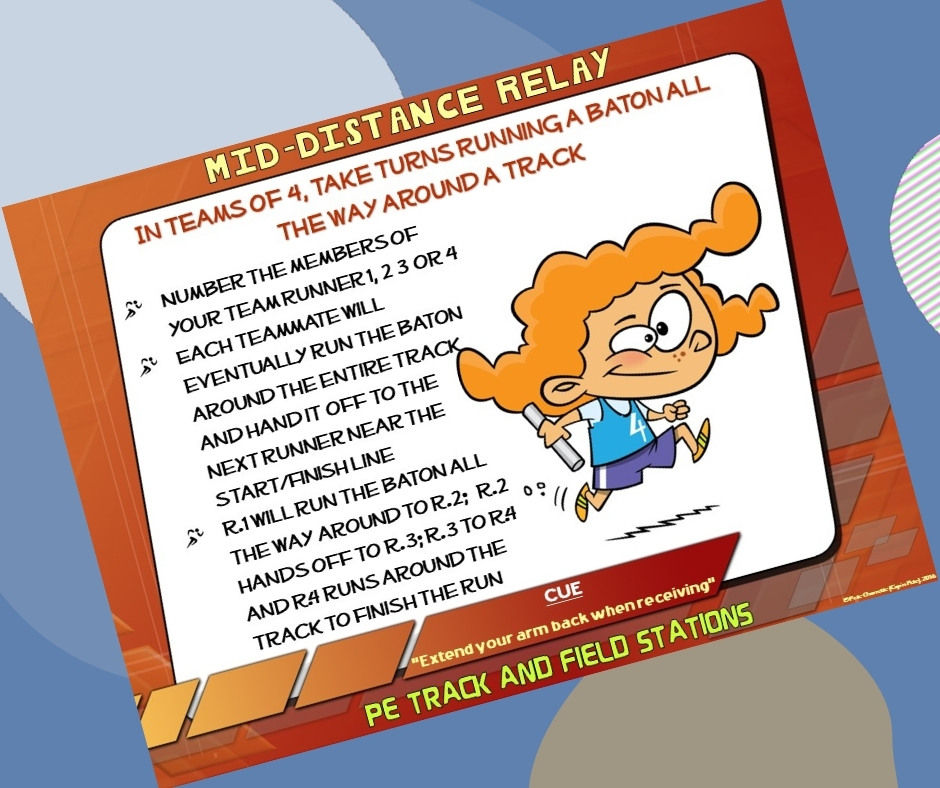
Teacher Instructions
Number team members as Runner 1, 2, 3, and 4
Each teammate will run the baton around the entire track and hand it off to the next runner near the start and finish line
Runner 1 runs the baton all the way around to Runner 2, who hands off to Runner 3, who hands off to Runner 4, who finishes the relay
Focus on smooth baton exchanges and maintaining speed through the handoff zone
8: Hammer (Tetherball) Throw
Overview - Students throw a tetherball using a hammer throw circle style out to an open field as far as possible, then measure their results.

Student Instructions
Grip the tetherball rope and swing the ball in a circular motion before releasing it out to the field
Stay behind the throw line before releasing the rope and ball
Have a partner mark your distance with a polyspot
Measure the distance with a measuring tape or premarked lines
Focus on building momentum through the rotation before releasing
9: Triple Jump
Overview - Students run to a hop line and then execute a hop, a step, and a jump sequence into a pit or onto a soft mat, then measure their results.

Student Instructions
Run fast to the hop line, then execute the sequence: 1. Hop on one foot, 2. Step to the opposite foot, 3. Jump into the pit or onto a soft mat landing on both feet
Have a partner mark your distance with a polyspot or beanbag
Measure the distance with a measuring tape
Practice the hop-step-jump pattern slowly before adding speed
10: Cross-Country Steeplechase
Overview - Students run a set distance on a grass or dirt marked trail while jumping over hurdles placed along the path.

Student Instructions
After the start signal, run around the marked trail for a set number of laps
Jump over any hurdles in your path without breaking stride
Pace yourself early in the run rather than going out too fast
Have someone time you, or race against a student at your ability level
Focus on smooth hurdle clearances and maintaining a steady pace throughout
For ready-to-use visual station cards for all 10 of these events, check out PE Track and Field Stations: 20 Run, Jump and Throw Zones on Cap'n Pete's website or on TPT.
Final Thoughts
Track and field is one of those units that has the potential to reach students who don't always feel like PE is their thing. The individual nature of most events means every student gets to define success on their own terms. A personal best is a personal best, regardless of where it falls compared to a classmate. That's a powerful thing to build into your program, and it's one of the reasons track and field tends to generate such genuine enthusiasm when it's taught well.
Whether you're working with kindergartners learning to run and jump for the first time or fifth graders chasing distance records in the shot put and long jump, the 10 stations in this article give you a flexible, adaptable framework to build from. You don't need a regulation track or expensive equipment. You need open space, some basic PE supplies, and a willingness to let students push themselves and have fun doing it.

Pic by Randi-Lee Hauptman @MrsHauptman4
A few reminders as you head into your planning:
Start simple and build from there. Students who experience early success come back motivated to improve.
Prioritize safety at every station. A quick walkthrough of expectations before each event keeps things running smoothly and keeps everyone safe.
Celebrate personal bests loudly and often. When students know their individual improvement matters, they invest more deeply in the work.
Mix in relays and partner events to bring the social energy up. Track and field doesn't have to be a solo experience, and the team moments are often the ones students remember most.
Good luck with your track and field unit! Your students are going to love it.
Need Some Free Resources?
Looking for ready-to-use sport station signs to add to your PE program right away? Cap'n Pete has you covered!

Looking for ready-to-use sport station signs to add to your PE program right away? Cap'n Pete has you covered!
Fill in the form below to download 20 FREE Sport-Specific PE Station Signs. This PDF digital download includes two visual station cards from each of the following sport station sets:
Base Games
Basketball
Football
Lacrosse
Paddle and Racket Sports
Soccer
Track and Field
This freebie set will serve your PE program for years!
Want Even More Track and Field Station Ideas?
The PE Track and Field Stations: 20 Run, Jump and Throw Zones resource gives you a complete set of 20 visual station cards covering running, jumping, and throwing events — all with clear instructions and high-quality graphics. Available on TPT.
Looking for a Complete Sports Station Collection?
If you want to take your entire PE program to the next level, check out Cap'n Pete's PE Sports Stations: 10 Product Mega Bundle. This comprehensive collection includes over 200 sports-themed station signs and cards covering 10 traditional sports:

Basketball, Base Games, Football, Floor Hockey, Lacrosse, Paddle and Racket Sports, Soccer, Track and Field, Team Handball, and Volleyball.
That's 20 stations per sport, all with detailed instructions and professional graphics you can use in your gym or any specialized learning space, year after year.
You can grab the full bundle from either of the following:


